“F40 was never meant to be raced.” – Ferrari F40 Tarmacworks FEATURETTE
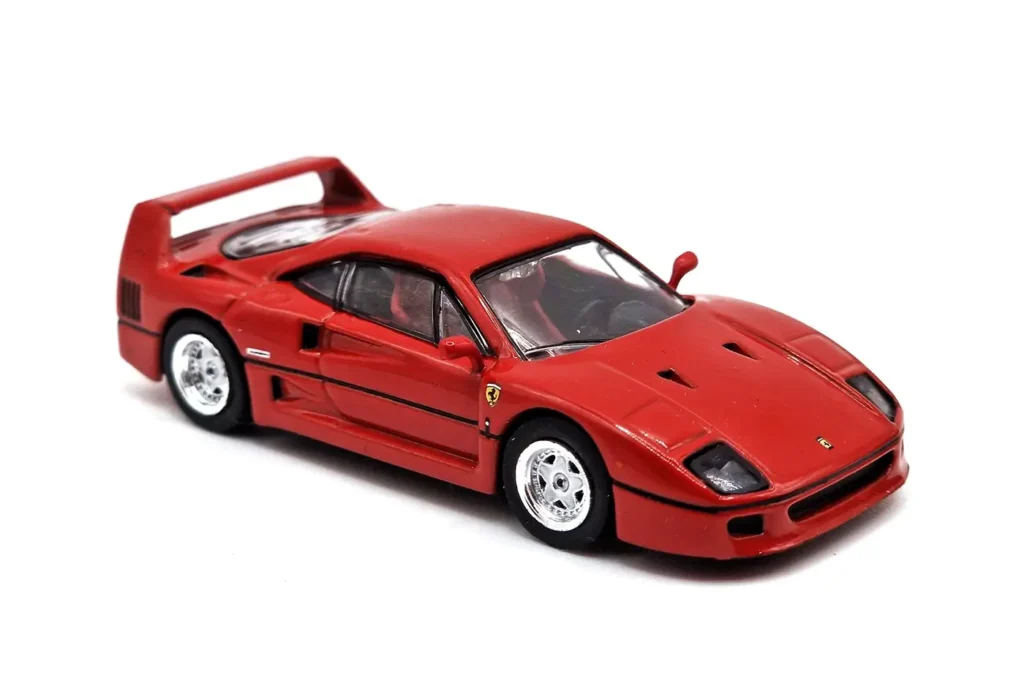
»Ask a child to draw a car and certanly he will draw it red.« You can hardly name a more iconic quote in the world of cars. And what is more iconic than a Rosso Corsa Ferrari f40? Born from the remains of Ferrari’s attempt on Group B rally programme with 288 GTO, the last creation of Commendatore, Enzo Ferrari, himself was created as a anniversary gift for the company’s 40-year-old history. Unveiled 21 July 1987 in Maranello, it was by far the most extreme road car Marranello ever produced. It was their first road car to have its chassis and bodywork built with extensive use of carbon fiber, Kevlar and aluminium, bringing the total weight to only 1254 kilos.
The Pininfarina-designed lightweight body was hiding a race derived (from 288 GTO evoluzione prototype) 2.9 litre, twin-turbocharged 90° V8 engine, pushing 471 horsepower at 7000 rpm. All this power came through a rear-mounted 5-speed manual gearbox directly to the rear custom-made Pirelli P-Zero tyres fitted to now iconic 5-spoke Speedlines. Its stats were brutal for the time: 324 km/h top speed and 0-100 km/h in 4,1 seconds positioned it as Ferrari’s fastest ever road car. It was also their most expensive car ever, costing 400 000 $ in 1987 or five times its predecessor, 288 GTO. The world was in love. So much so that Ferrari had to triple their production, from the planned 400 units to 1311 between 1987 and 1996. All cars came from the factory in Rosso Corsa and featured left hand drive configuration, however some were later repainted by Ferrari themselves or converted to race cars.

One thing that was apparent from the start was that this was not an easy car to drive. As if 471 horses weren’t enough already, this car has a significant turbo lag from its water-cooled twin turbos. Combined with the fact that this car has no driving assists, rear wheel drive, a manual gearbox and the fact that it weighed next to nothing, a lot of owners felt like they were driving a really expensive go-kart. Which is exactly what a racecar has to feel like. But here's the catch : Ferrari originally never planned to take F40 racing. Privateers, however, disagreed, thinking that F40 had potential to compete. Ferrari gave their blessing for teams, specifically their friends at Michelotto, to start building race cars. While Michelotto was the primary culprit for converting F40 into racing machines, they weren’t the only ones. Generally there are 4 main versions privateers created with Ferrari’s blessing: LM, GT, Competizione and GTE. Today we will look at each spec and their diecast representation.
A quick disclaimer: while all the cars were made in Ferrari’s partnership with Michelotto, a lot of them were made by other specialists and teams. Because of that, it is a problem to keep track of them and their exact numbers. Some of them received unique upgrades during their life as racecars. Additionaly some were converted to higher spec classes during their competition period.
Ferrari F40 LM

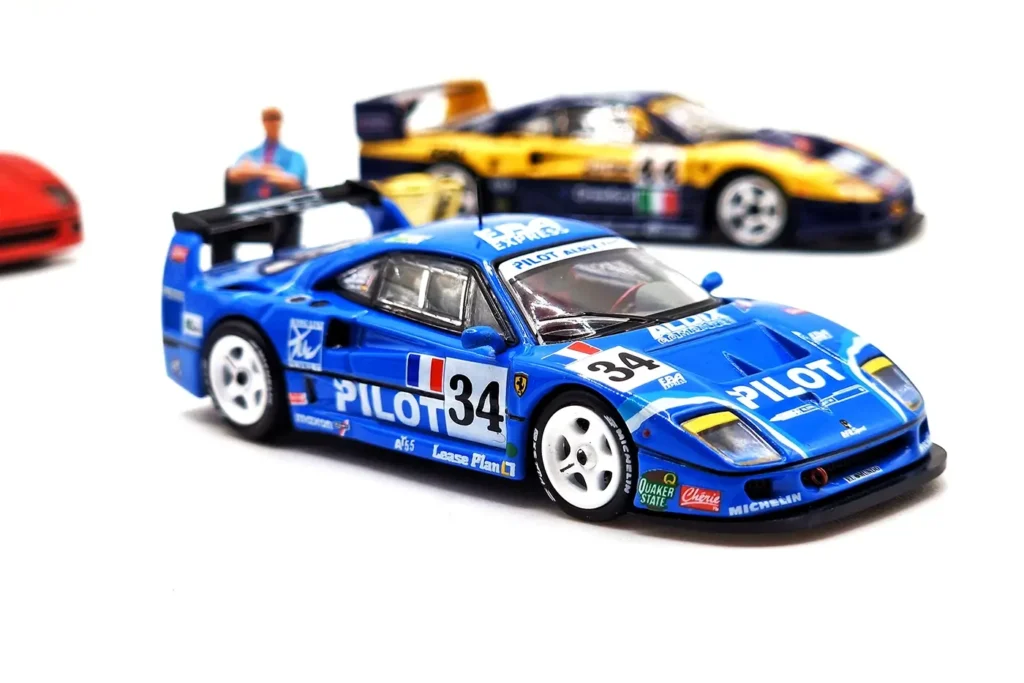
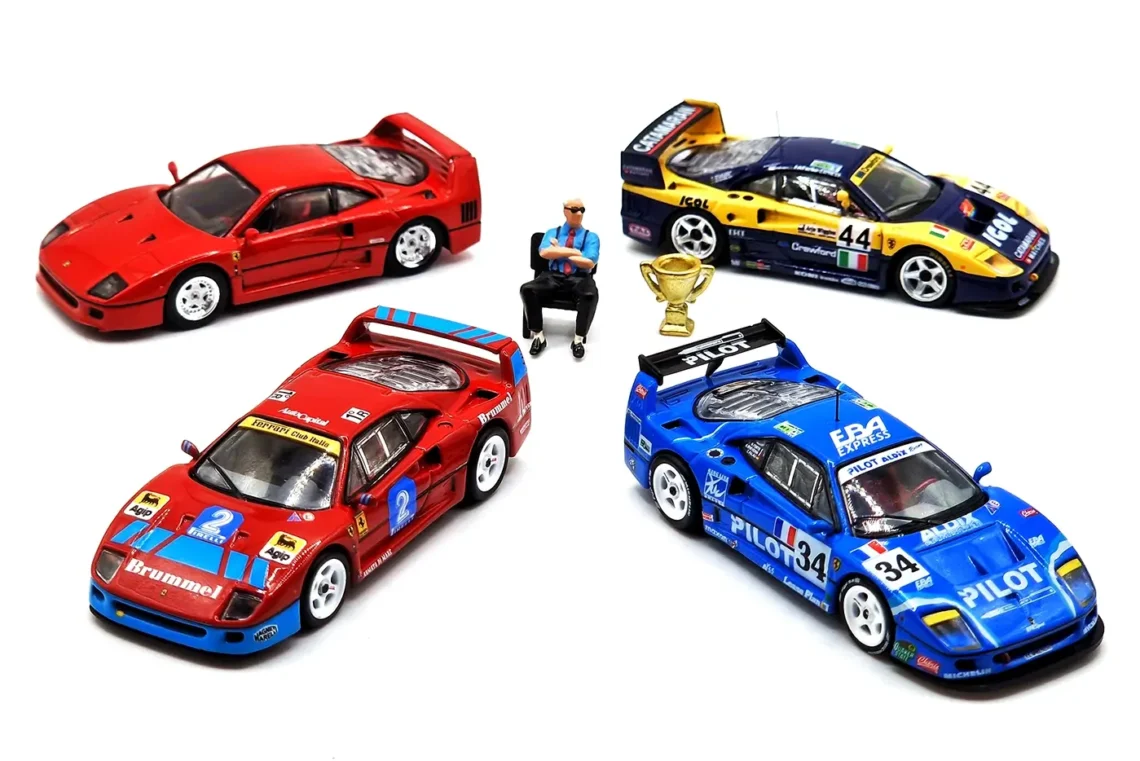
The first race coversion programme was carried out by Italian Ferrari specialist company called Michelloto Automobili, which helped designing some parts of the original road car. They created 19 LM spec cars but additional demand bumped the number to 27, although those cars were built by other racing teams. Their fist spec was for an IMSA GTO class, and was beyond bonkers. While we will not cover it simply because it is LM only in name, it was a genesis (template?) for all the cars built by Michelotto. These cars sported numerous upgrades from the original, including new carbon fiber aero package, fixed headlights and a new hood. The engine also wasn't overlooked as they raised displacement to 3 litres. Theinterior was stripped to the bare minimum and a digital instrument cluster was installed. This specification raced all around the world, from IMSA and Le Mans to appearances in first years of JGTC. The cars raced by diferent entries in GT championships all around Europe, achieving notable results like winning 4 Hours of Vallelunga in BPR Global GT Series in the hands of the Strandell team. Apart from that, it wasn't very sucesful and was later phased out by the more powerfull GTE version. TarmacWorks made a couple of variations of this car in many different colourways, some having clean colours and others real racing liveries from the period (notable ones include #34 campained by Pilot in 1995 24H of Le Mans).
Ferrari F40 Competizione

The F40 competizione is an interesting variant. Originally
Ferrari created it for people who wanted to have an LM, but not necesarrily
race it. So Competizione was born. It is
an even more powerful version of LM, rated at 691 horsepower at 8100 rpm. Some
say it could achieve speeds of up to 367 km/h. A lot of them, as mentioned,
were never raced and mostly spent their
lives in private collections. As for the world of diecast, while Tarmac Works
never officially made a diecast representation of Competizione, some speculate
that their »lightweight« version is just that. Additionally, Hot Wheels
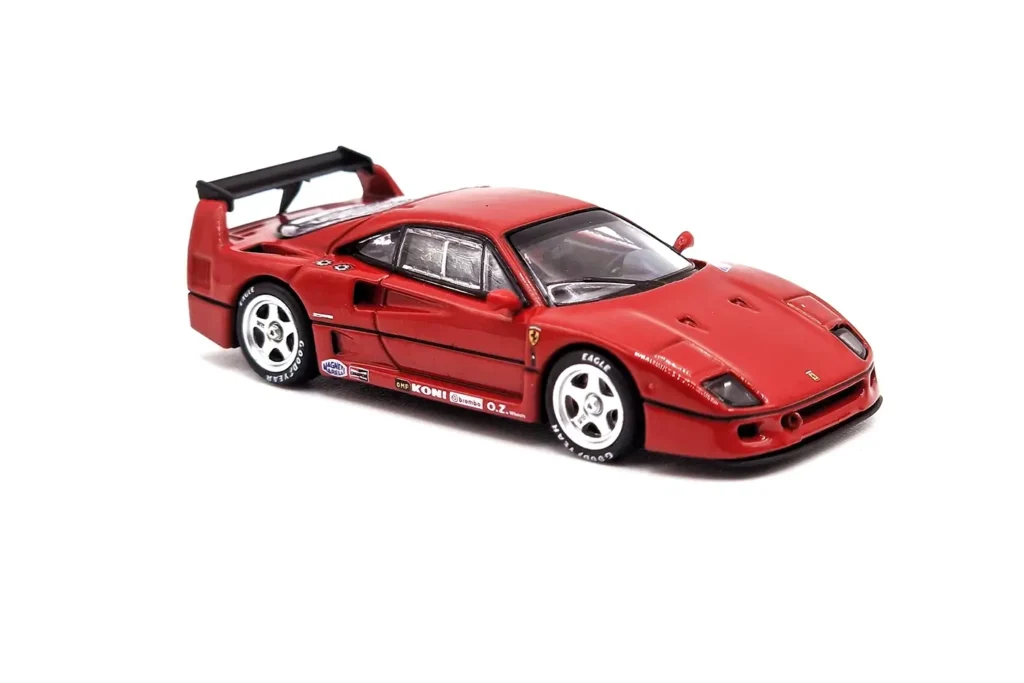
released a Competizione model in their Mainline series just last year. However, Tarmacworks offered the interim solution shown in the picture above – a blend of the road-going F40 with elements of the LM – which represented the transition phase from the road car to the racing version.
Ferrari F40 GT

Coming to a car that was made in a diecast form
by Tarmac, F40 GT was created with the help of Michelotto, too. This variant
was meant to compete in the Italian GT championship.
The Engine on those things was upgraded up to 560hp and other tweaks included lighter magnesium wheels,
lighter bodywork (although not as complex as LM or GTE), improved brakes and
cooling, as well as a new exhaust system. They were quite quick, too, winning
the 1994 Italian GT Championship. In total 7 known conversions exist. Tarmac Works
did a great job with this one,
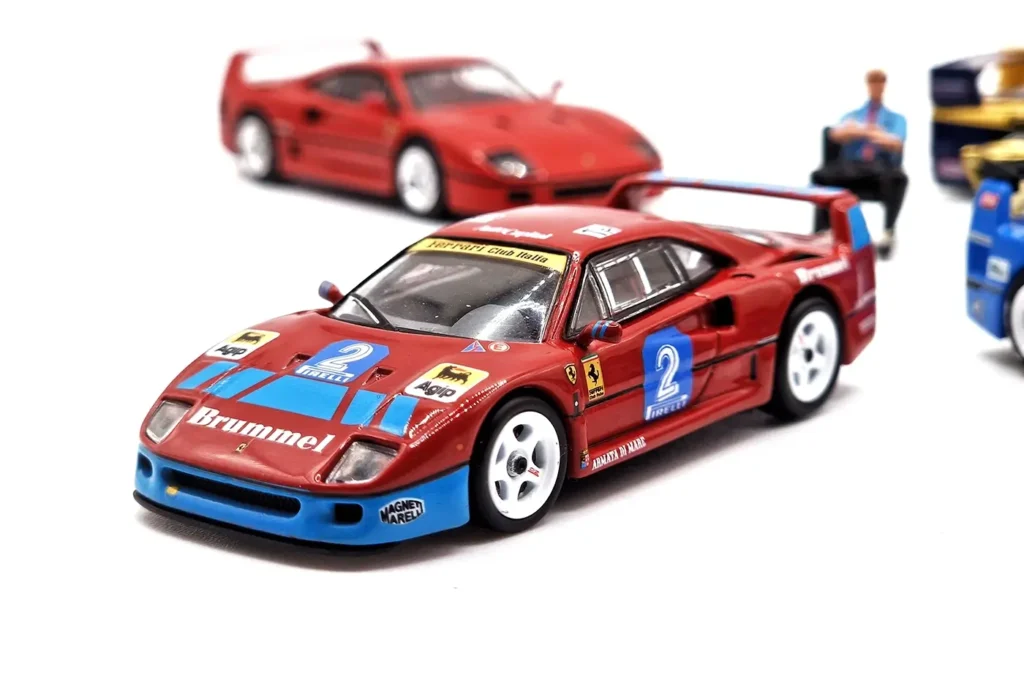
producing Brummel #2, Shell #7
and the most important one, the #1 Totip sponsored car which won the 1994
championship as Hong Kong Toycar Salon Exclusive.
Ferrari F40 GTE

The final iteration of the racing F40 was GTE (GT Evoluzione). Their job was to take on Le Mans and BPR Global GT Series in the then new GT1 class. Those cars were drastically modified. The engines were enlarged to 3.5 in 1995 and up to 3.6 litres in 1996. The final horsepower readings were somewhere in the range of 620. Additionally, numerous aero upgrades were launched during the years it competed, including a new wing, front splitter, rear diffuser, new air intakes and air extractors. The cars also had a Magneti Marelli Dashboard and BBS E88 wheels. Its first appearance was in the 1995 BPR Global GT series, where it was campained by Ferrari Club Italia and the famous Jolly Club team. While they had a strong start, their car was unreliable and they only won 2 podiums d-uring the year. In le Mans of the same year, they weren't much better, so both cars retired. 1996 was kinder to them from the competitive standpoint. Both cars entered in the first round in Paul Ricard and finished second and third. Those cars also entered Le Mans in the same year, but neither was able to finish because of reliability failures. They took their first win in 4 hours of Anderstorp that season though, specifically car #44 driven by Anders Olofsson and Luciano Della Noce. This was also the last time GTE won a race, it was gradually replaced in the following years.
The car that won the only race of all GTE, chassis #ZFFGJ34B000090001, originally started life as a Michelloto converted F40 LM and was campaigned by Strandell all the way to 1994. In 1995 it got its GTE conversion and was aquired by Ferrari Club Italia. whose banner it raced under until November 1995 when it was sold to Ennei Racing, later known as Ennei/Igol racing That's where it got its most iconic paintjob and Ollafson behind the wheel. The car stayed with the team until its last recorded competitive outing in 1996.
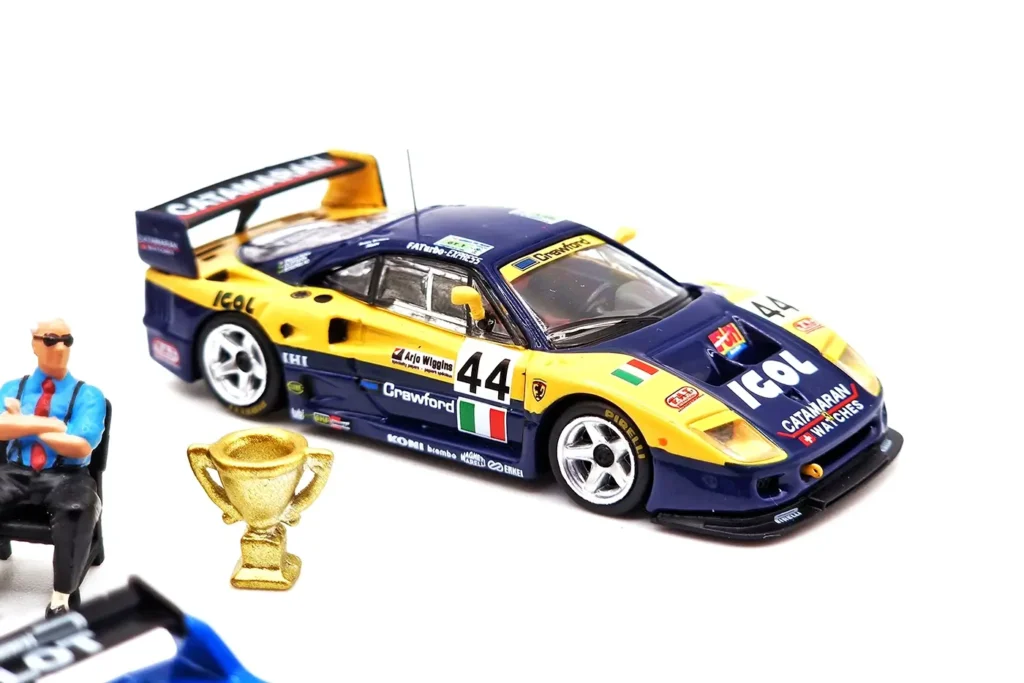
We are lucky taht the car community and diecast manufacturers keep these cars in our memories. Tarmac Works created a casting for it and specifically for the car that won the race. Number 44 of Olafsonn and Della Noce is done in beautiful navy and yellow livery, with prominent logos including Catamaran Watches and Igol (the name of the team that campaigned the car). The details on it are superb, having all the period correct sponsors and colours. And since this is a whole new casting, we hope that Tarmac will try some other decos on this car. It is already aviable for preorder with online retailers and has already dropped on the Tarmac Works official website.
All in all, racing F40’s are definetely products of their time and held a unique place in motorsport of the time. Budgets weren’t yet astronomical and rules were much more relaxed. An aditional important factor was Ferrari’s willingnes to outsorce the race program and give free reins to teams using F40. While they aren't the best and most successful racing machines, they still have a special place in the hearts of 90’s racing enthusiasts. Not to mention that they now cost almost 2 times more than normal F40s. Thank you everyone for reading this feature, racecars are a really big passion of mine and this article was a joy to write. Hope you enjoyed reading it and have a nice day!

You May Also Like

The legacy of JGTC Super GT – TAMIYA COLLECTION FEATURETTE
September 8, 2024
The RISE AND FALL of the DTM – MiniGT, Tarmacworks, Hot Wheels FEATURETTE
November 1, 2023