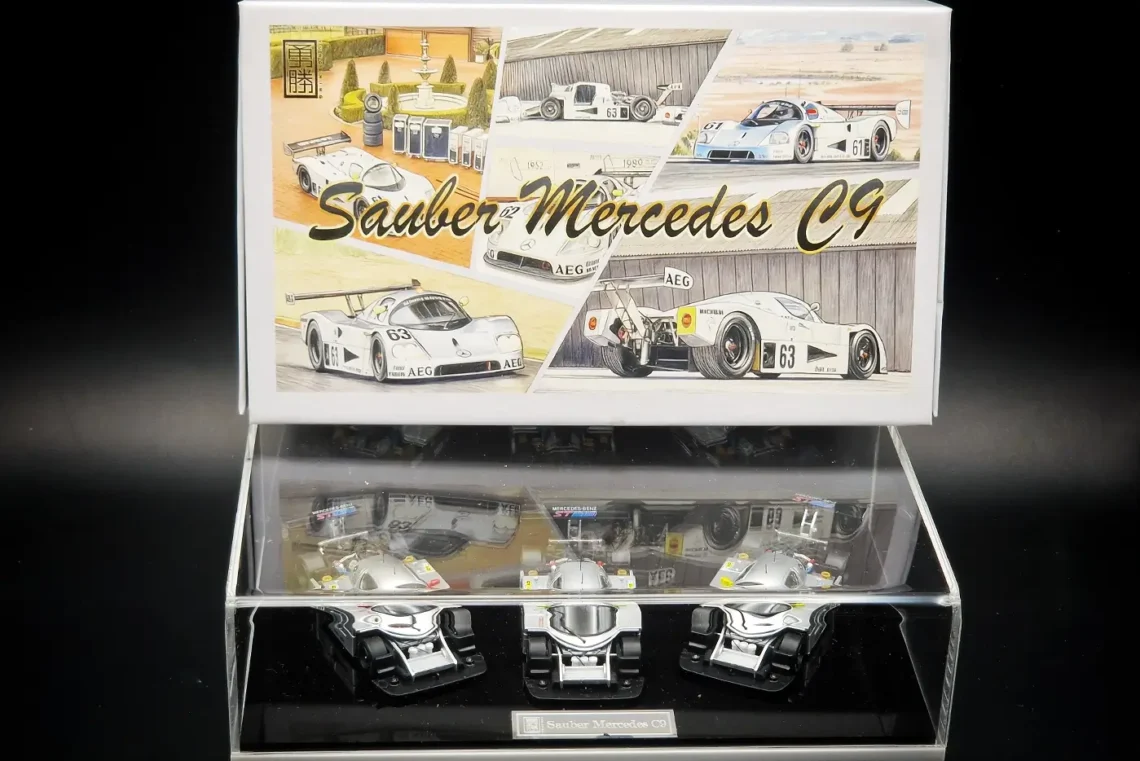
Sauber-Mercedes C9 by Yung Shing
Yung Shing

Sauber-Mercedes C9: The long journey to the top – Yung Shing FEATURETTE
Jolly 80’s or something resembling an introduction

The 80’s are considered by many as the golden age of motorsport. And when you consider, it’s hard not to see why. In the same decade we got turbocharged monsters of F1, rocketships and absolute death traps of Group B rally and fire breathing monsters from IMSA’s GTP and GTO classes. Le Mans wasn’t an exception, blessing viewers with the absolute art that was Group C machinery. Group C produced some of the most iconic and insane machines that have ever raced. They sure are some of my favourite cars ever made and I still have posters of Toyota 87C and Pegueot 905 Evo 2 on my walls , as well as some of the cars in diecast form.

We have a particular fondness for one of those Group C models that we have in my collection It's a Sauber-Mercedes C9 number 63 from Hot Wheels Premium Mercedes Diorama, which we bought on Ebay years ago. It’s not the the car with the most wins from the era, nor is it the best sounding or the most beautiful, but its results and its looks are not what separates it from the rest. Its story, full of ups and downs, is what makes this car an icon of Le Mans.

Before we forget...No, it wasn’t just Hot Wheels that released the C9 in 1:64 scale; a Chinese manufacturer called Yung Shing also got in on the act and has brought what is arguably one of the most detailed models ever to the market. Or should we say: three of them? All three from the legendary 1989 season? Number 61, 62 and 63? All about these masterpieces in this article. So strap in, grab a coffee or tea and let's look at the journey of Sauber-Mercedes C9!

Sauber-Mercedes C9 by Hot Wheels Premium
The very first release of the Sauber C9 by Hot Wheels – admittedly, we gave the engine bay a bit of a touch-up ourselves to make it look even better than it already does. Hot Wheels went on to release further versions later on.

What is a Group C

To understand the sheer insanity of this racecar and the story surrounding it, we must first understand the rule-set that allowed the creation of such machinery. In the early 1980’s endurance racing was a mess. There were 2 top classes, Group 5 silhouette racecars and 2-seater sports prototypes called group 6. By the end of those regulation cycles, both categories became too expensive, too convoluted for manufacturers and privateers alike and way too fragmented. Because of that, FIA decided to replace both of them with the introduction of a new rule-set, which they named Group C. They were positioned as a top class of sportscar racing in seria like World Endurance Championship (later renamed into World Sportscar Championship), which included 24h of Le Mans, and they were widely used around the world in local series. Regulations came into effect in 1982 and quickly gained popularity. At one point they were as popular as Formula One. But this led to their demise. Those regulations ran until 1993, when they were cancelled because of dwindling manufacturer interest, expensive budgets and regulatory changes.

The main selling point of Group C was the new way in which they restricted the teams. Rather than using traditional engine type or size limits, they put limits on fuel efficiency. That, closed cockpit design and maximum weight limit were the only strictly regulated parts of the rulebook. That engineering freedom was a catalyst for a massive arms race between manufacturers. Ford and Porsche came first, quickly followed by other manufacturers, big and small, from small engineering firms such as Zackspeed, and Lola and Spice to big manufacturers like Pegueot, Lancia, Jaguar, Toyota and many more. This ruleset produced some of the most iconinc racecars and liveries ever created: Porsche’s 956 and 962 family [we also wrote an article about these gems here on toycarsaddict.club, so be sure to check it out], Jaguar Silk Cut XJR programme, the Pegueot 905 which shattered the top speed record at Le Sarthe, Calsonic Nissan R89, Mazda’s iconic rotary powered 787b and so much more. One of those legends is the car of our story, Sauber-Mercedes C9, a result of an alliance between German automotive powerhouse Mercedes-Benz and a small Swiss racing team by the name of Sauber.

Sauber-Mercedes C9 by Yung Shing
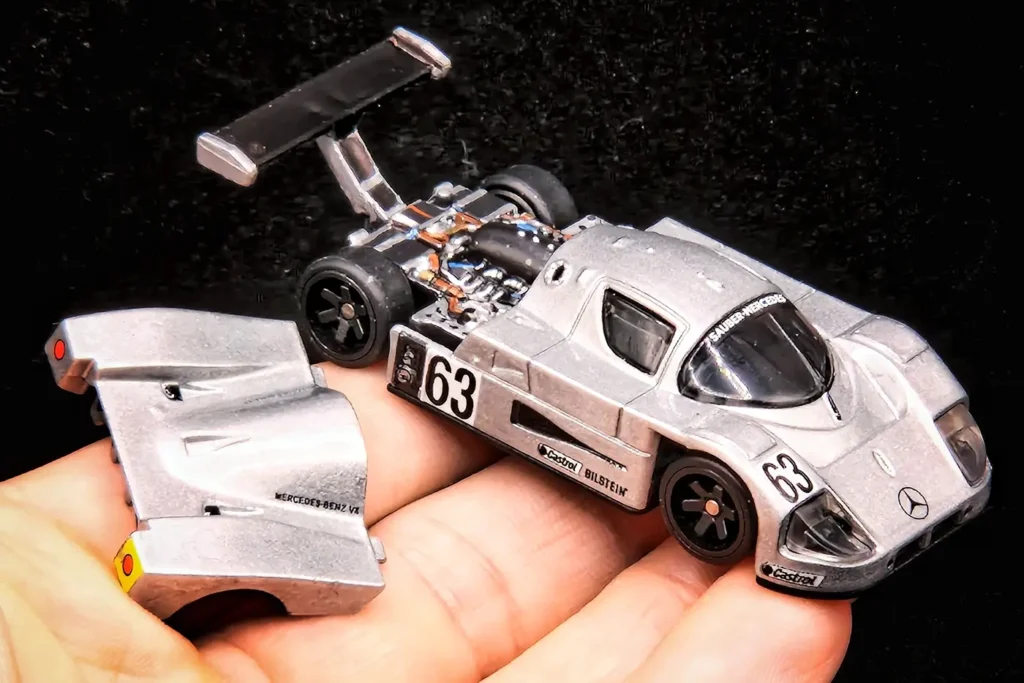
The Sauber C9 is an absolutely legendary piece of motorsport history – even from the outside, Yung Shing’s model captures the racing spirit of the 80s and 90s with a lovely retro touch – we love it!c

An unlikely candidate

While late 80’s Group C racing was dominated by large manufacturers, there was still room for independent teams. Enter Sauber Motorsport. While most motorsport fans know them from their Formula 1 team, they first started building prototypes in the 1970’s. Created by Peter Sauber, this small Hinwill-based team quickly became a staple in sportscar racing throughout Europe. However, they were never particurarly quick or famous. Their only flash of fame arrived when their car broke into the top 10 of the 1983 edition of 24h of Le Mans, making them the only manufacturer that disrupted Porsche’s complete lockout of top 10. They were immortalized in Stuttgard’s ad »Nobody’s perfect«. Sauber had flashes of speed here and there, but they needed something to push them into contention for victories. They purposefully decided to stop racing for a year while they looked for a new engine partner for the 1985 season.

Help arrived from Germany. At the time, Mercedes was looking for a way to enter endurance racing for the first time since 1955. They had an engine, an 8-litre twin-turbocharged M117 V8 engine, but they didn't have a chassis to put it into. And they definitely didn’t want to put in full factory effort. Since Sauber desperately needed a new engine, the Germans became official engine supliers for the team.

The First year of their partnership wasn’t excactly the dream start that the team had hoped for. The C8 prototype was unreliable and crashed at the 1985 Le Mans, derailing the whole project and making it its only apperance that year. The following year, a new version of the car was rolled out and things were looking bright. Fielded by the Kouros Racing Team (Sauber struck a deal with the cologne manufacturer), the car started to achieve decent pints finishes culminating in a win in the 1986 1000km of Nurburgring with Pescarolo and Thackwell behind the wheel. Finishing fifth in that season, the team decided to go back to the drawing board and that's how C9 was ultimately born.

Sauber-Mercedes C9 by Yung Shing
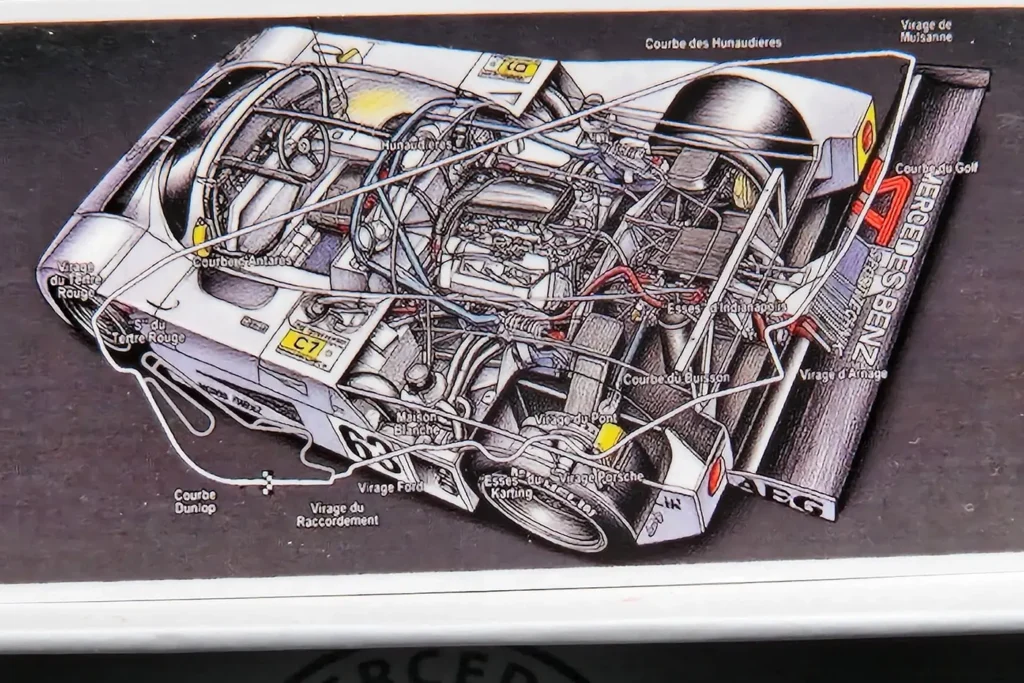
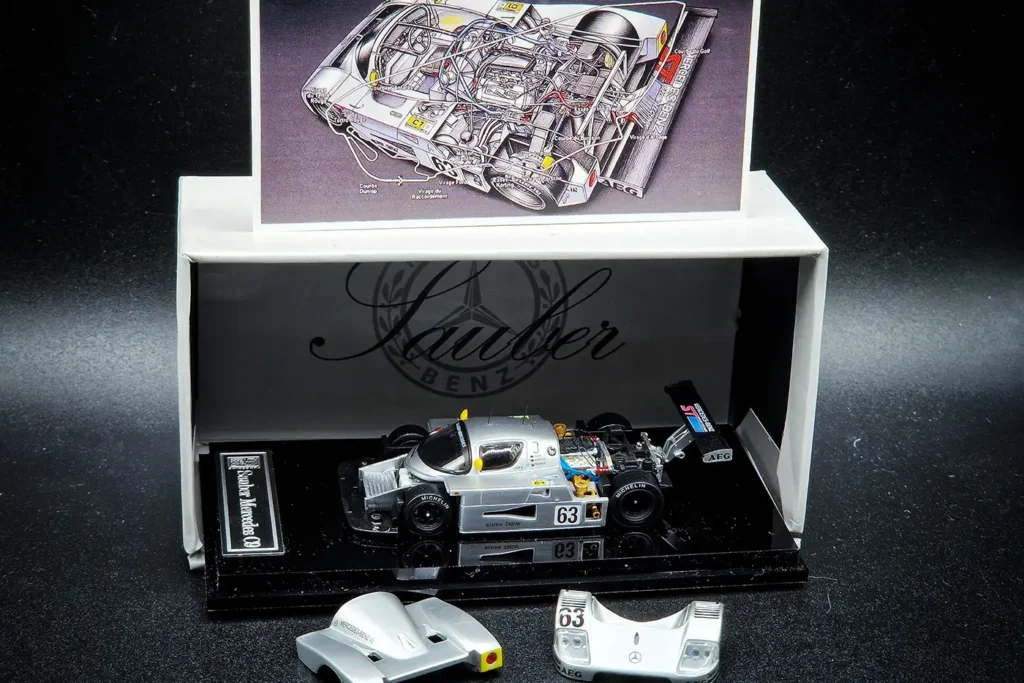
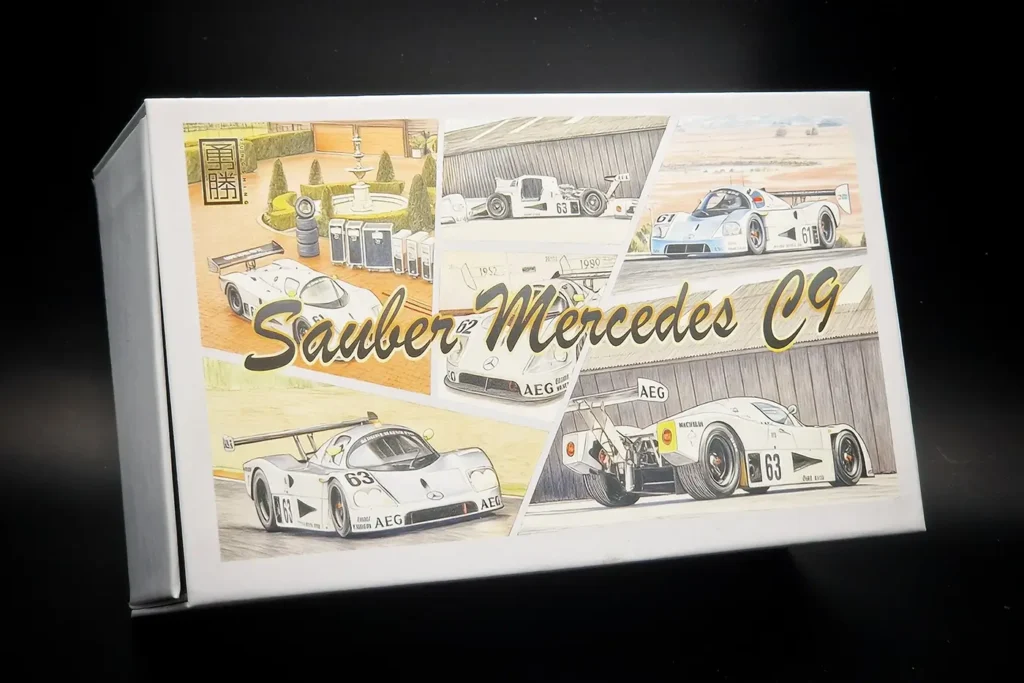
Also included with the individual model: straight from the drawing board onto the card, a stunning X-ray image of the C9 alongside the layout of the legendary Le Mans circuit – naturally, without the chicanes; back then, it was all about hitting 400 km/h at full throttle!

Anatomy of a monster

At first glance the Sauber-Mercedes C9 prototype was an evolution of the C8. It retained the same structure for the monocoque and chassis, but it was heavily reinforced and stiffened. It also had a new suspension, now spotting double wishbones and coil springs over shock absorbers. The engine, while retaining the same bones as the legendary M117, was overhauled multiple times through its competitive life. A big upgrade arrived in 1989. It included new KK&K trubos, a lighter crackshaft, new internals, 16 valve heads and a new lubrication system that pushed the engine to 820 horspower and 597 lbs of torque in its latest configuration. It all went trough the Hewland 5 speed transmission. Its 7000 rpm limit was lower than the competition, but it allowed the engine to be more reliable and created a flatter torque curve. It also allowed the engine to be tuned for a variety of conditions, from sprint races to endurance runs. The car was very light, sitting at only 905 kilograms, so its power-to-weight ratio was absurd. In addition, it produced a lot of downforce, almost 2,3 tonnes in its sprint configuration. The bodywork was redone, as well, with the NACA ducts removed from the dorsils and a new front splitter plate added. The rear deck was entirely reprofilled and the rear wing now sat on central support only. A lot of lightweight materials, mostly aluminium, were used in the car's construction A total of 6 chassis were built in between 1986 na 1989.

Sauber-Mercedes C9 by Yung Shing
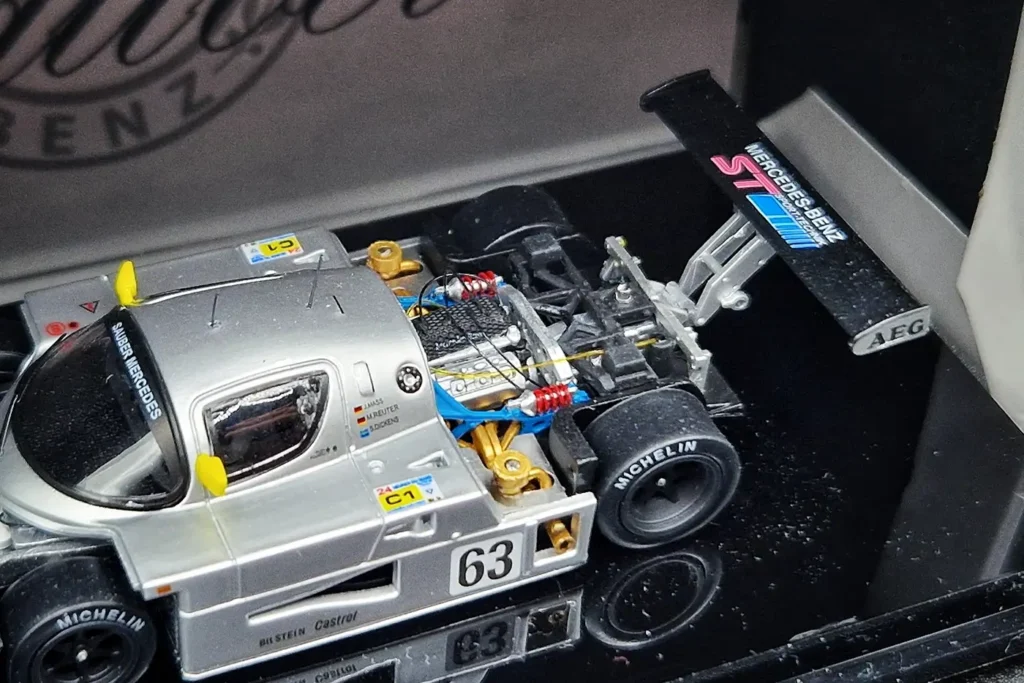
A fantastic sight: the front and rear covers can be removed, revealing one of the most detailed engine compartments in 1:64 scale. Everything mentioned in the article can be applied here to great effect and offers plenty to admire!

A rocky start and a new era of partnership

The C9 was entered in the 1987 World Sportscar Championship under the Kouros Racing banner but didn't prove the breakthrough the team had hoped for. It only finished on 3 occasions, suffering a lot from reliability issues. It had potential, however, as was clearly demonstrated at Le Mans, when the team set a new lap record. Sadly, it retired just one lap later due to gearbox failure.

Yet Sauber never gave up. They returned as Sauber-Mercedes for the 1988 season and, for the first time, officially backed by Mercedes in WSC and Le Mans. The car received crucial upgrades, including new radiators, improved turbos, a central support rear wing and another redesign of the rear deck. It also featured a new livery, courtesy of AEG Olympia. The car finally started delivering. It won 5 races that season and was bested only by Jaguar’s legendary V12 XJR-9. However, they didn’t start Le Mans that year , because there were serious concerns the Michelin tires would not survive the loads the car put onto them. This forced them to withdraw from the race, but it would all come to them the year that followed.

Sauber-Mercedes C9 by Yung Shing
The AEG Olympia livery: extremely simple in design, yet incredibly distinctive. I reckon only the Sauber C9 manages to pull this off – with very few sponsors and minimal colour accents, it’s still an absolute showpiece, just like the Mercedes Silver Arrows of the 1930s!

Silver Arrows unleashed in 1989

The 1989 season was a make-or-break for the team. With a fully redesigned engine and a full silver livery, the team wanted nothing less than a win. They absolutely dominated the season, winning 8 out of 9 races that year, including the crown jewel, the 1989 24 Hours of Le Mans. They fielded 3 cars, all driven by great drivers. In the qualifyings, car number 61 clocked 400km/h on the Mulsanne Straight, a new top speed record and one of the highest speeds on a racing circuit ever recorded. Car 62, driven by Schleser, got pole position. But it was car 63, driven by Jochen Mass, Manuel Reuter and Stanley Dickens, which got the win after fighting day and night from 11th spot on the grid. All in all C9 finished 1st ,2nd and 5th at the race. The driver of car number 62, Jean-Louis Schlesser, took the title of WSC at the end of the season. The only race that C9 lost was in France at Dijon, because of problems that Michelins encountered in extreme heat. Everything else was a clean sweep for the Swiss-German team.

Sauber-Mercedes C9 by Yung Shing
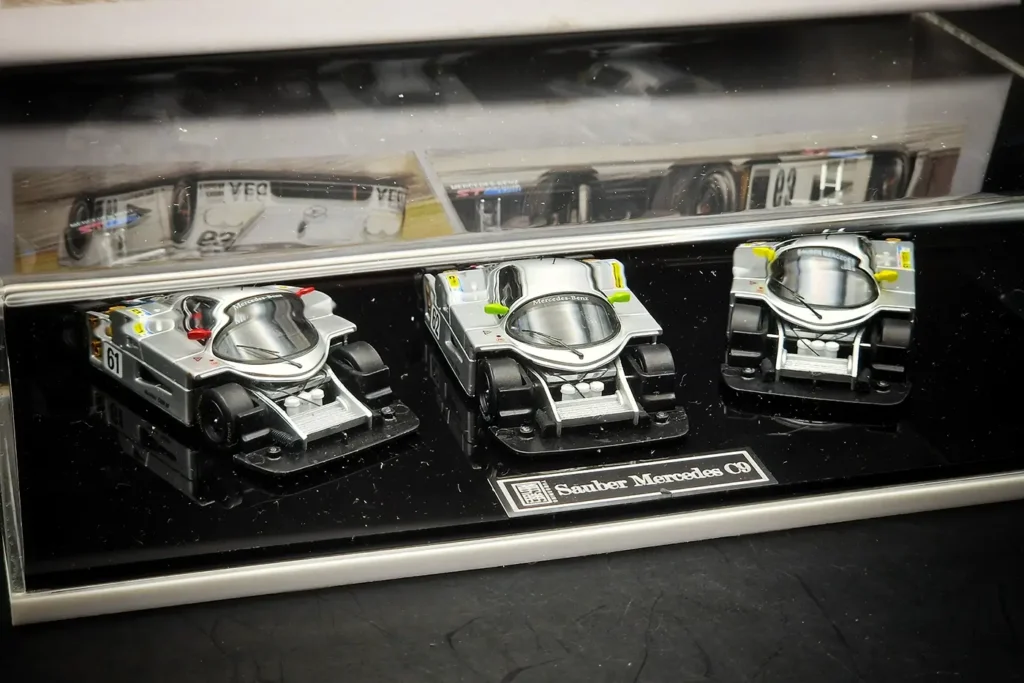
As well as the 1989 Le Mans winner, which is available individually in shops and can be recognised by its yellow wing mirrors and the number 63, you can also buy the whole trio comprising numbers 61, 62 and 63. All feature removable front and rear sections – an absolute must-have for Sauber fans and Le Mans enthusiasts!

End of a fairytale

Everything ends at some point and our story is no different. The C9 was the only car in its family that enjoyed such a level of domination. In 1990 it was replaced by C11 and in 1991 by C291. While both of the cars were quicker, they didn’t achieve the same level of success as their predecessor. A big part of that were the new regulation changes, which aimed to help save the already sinking ship that was Group C. Cars just got too expensive, too fast and there wasn't any interest anymore from manufacturers and public alike. At the same time, the partnership between Sauber and Mercedes slowly started to dissolve. They both achieved what they had set out to achieve. In 1991 their partnership was formally ended. Both now set their sights on Formula 1. Sauber joined the pack in 1993, competing to this day, now as Audi in specific functions. And Mercedes? We think we already know the answer, the 2026 could be THE season again for the AMG F1 team featuring George Russell and Kimi Antonelli as their driver pair.

Now...what has since happened to all the chassis? One remanined in the Mercedes and one in the Sauber museum. The rest are scattered around the world, enjoying their lives in private collections and are occasionally taken out to shred tires on events like the Goodwood Festival of Speed or Monterey Car Week. As of the moment of writing this article, Mercedes is showing C9 at Ultrace Germany event. If you would like to buy one, you better have some money in the bank, because they trade north of 5 million dollars. If you ever even find one for sale, that is.

If you don’t have a spare 5 million lying in the bank, there are still many ways to enjoy the C9. A lot of diecast brands made replicas of C9 in every scale imaginable down to 1:64 by Hot Wheels and obviously by Yung Shing. It has also been featured in many videogames and simulators like Assetto Corsa, Automobilista 2, Project Cars 2 and most recently, Project Motor Racing.

Persistence conquers all

At the end of this article we think we know why the story of C9 is so intriguing to us. Not because of the heritage or the car itself, or its results,but because of the determination of the team which refused to give up and persisted. They faced many setbacks along the way, and often when it seemed they had taken a step ahead they actually took two steps back. But in the end they achieved their goal. It is the journey that sets apart the icons of the sport from just the winners.

Thank you so much for reading this feature until the end, we hope you enjoyed reading this walk down history lane as much as we enjoyed writing it and we hope that it will motivate you never to give up. Good morning, good day or good night, wherever you may be, dear reader! LET'S RACE!

This artice was written by:
georgij jazbec
Georgij Jazbec
Blogger, Diecast Collector and Car Enthusiast

Get 24h Le Mans Legends here:

Leave a Reply

Your email address will not be published. Required fields are marked *